
Harley-Davidson Service Manuals: A Comprehensive Guide
Harley-Davidson service manuals are essential resources for owners and mechanics, offering detailed instructions for maintenance, repair, and troubleshooting. These guides ensure proper vehicle upkeep.
What are Harley-Davidson Service Manuals?
Harley-Davidson service manuals are meticulously crafted, comprehensive guides designed to assist owners, enthusiasts, and professional mechanics in the maintenance, repair, and overall upkeep of their motorcycles. These manuals aren’t simply collections of diagrams; they represent a detailed understanding of each Harley-Davidson model, providing step-by-step instructions, torque specifications, and exploded views of components.
They cover everything from routine maintenance tasks like oil changes and brake adjustments to complex procedures such as engine rebuilds and electrical system diagnostics. A genuine Harley-Davidson service manual ensures that repairs are performed correctly, preserving the motorcycle’s performance, safety, and value. These resources are invaluable for anyone seeking to understand the intricacies of their machine and perform work themselves, or to effectively communicate with a professional mechanic.
Types of Harley-Davidson Service Manuals Available
Harley-Davidson offers several types of service manuals to cater to different needs and preferences. Traditionally, paper manuals were the standard, providing a physical, durable resource for the workshop. However, digital manuals are increasingly popular, offering convenient access via online subscriptions or downloadable formats.
Official Harley-Davidson manuals are the gold standard, providing the most accurate and detailed information. Third-party providers like Clymer and Haynes also offer manuals, often at a lower price point, though they may vary in depth and accuracy. Model-specific manuals are crucial, as procedures differ significantly between Evolution, Twin Cam, and Milwaukee-Eight engines. Some manuals focus on specific systems, like electrical or fuel injection, while others provide complete coverage. Choosing the right manual depends on the scope of work and desired level of detail.
Why Use an Official Harley-Davidson Service Manual?
Official Harley-Davidson service manuals are paramount for ensuring accurate and reliable motorcycle maintenance and repair. These manuals are created by the manufacturer, guaranteeing compatibility and precision for your specific model and year. They detail procedures validated by Harley-Davidson engineers, minimizing the risk of errors that could lead to further damage or safety concerns.
Using an official manual safeguards your motorcycle’s warranty, as modifications based on unofficial guides may void coverage. They provide detailed wiring diagrams, torque specifications, and exploded views, crucial for complex tasks. While third-party manuals can be helpful, they often lack the depth and accuracy of the official versions. Investing in an official manual demonstrates a commitment to preserving your Harley-Davidson’s performance and longevity, ensuring a safe and enjoyable riding experience.

Understanding Harley-Davidson Model Coverage
Harley-Davidson model coverage in service manuals spans Evolution, Twin Cam, and Milwaukee-Eight engines, each requiring specific procedures due to their unique designs and components.

Evolution Models (1984-1998): FLH, FLHT, FXR
Harley-Davidson Evolution models, produced from 1984 to 1998, including the FLH, FLHT, and FXR, are comprehensively covered in dedicated service manuals. These manuals detail the 80 cubic inch (1340cc) and later 95 cubic inch (1550cc) engines, focusing on carburetor adjustments, ignition timing, and valve train maintenance.
Specific attention is given to the FXR chassis, known for its robust construction and handling characteristics. Manuals provide detailed instructions for suspension overhaul, including fork rebuilds and shock adjustments. Electrical system diagnostics are also thoroughly explained, covering wiring diagrams and troubleshooting procedures for common issues like charging system failures and lighting problems.
Furthermore, these manuals offer step-by-step guides for engine rebuilds, transmission repairs, and primary drive service. Clymer manuals, a popular third-party option, often provide detailed exploded views and torque specifications, aiding in accurate assembly and preventing potential issues. Proper use of these resources ensures the longevity and reliable performance of these classic Harley-Davidson motorcycles.
Twin Cam Models (1999-2016): Specific Model Years & Engines
Harley-Davidson Twin Cam models, spanning 1999 to 2016, necessitate model-specific service manuals due to engine variations and evolving technologies. Early Twin Cams (1999-2005) featured 88 and 95 cubic inch engines, while later iterations (2006-2016) included 96, 103, and 110 cubic inch options, alongside fuel injection upgrades.
Manuals detail procedures for fuel injection system diagnostics, including troubleshooting sensors and optimizing engine mapping. They also cover hydraulic clutch adjustments, cam chain tensioner service, and oil pump maintenance – critical for Twin Cam reliability. Specific attention is given to models like the Dyna, Softail, and Touring lines, addressing unique component layouts.
These resources provide detailed wiring diagrams for the CAN-bus electrical systems introduced during this period. Comprehensive guides for transmission rebuilds, primary chain adjustments, and final drive service are also included. Utilizing the correct manual for your specific year and engine size is paramount for accurate repairs and maintaining peak performance of your Harley-Davidson.
Milwaukee-Eight Models (2017-Present): Detailed Coverage
Harley-Davidson Milwaukee-Eight service manuals offer exhaustive details for these modern engines, introduced in 2017. These manuals cover the significant advancements, including dual throttle bodies, improved oil cooling, and counter-balancing, crucial for optimal performance and longevity. Detailed sections address the four-valve cylinder heads, requiring specialized tools and techniques for valve adjustments and inspections.

Coverage extends to the electronic throttle control systems, detailing diagnostic procedures and calibration methods. Manuals provide in-depth wiring diagrams for the updated electrical architecture, including the CAN-bus network and associated modules. Specific attention is given to models like the Street Glide, Road Glide, and Limited, outlining unique component configurations.
These resources also include comprehensive instructions for servicing the hydraulic clutch, six-speed transmission, and final drive. Proper use of the service manual ensures accurate repairs and maintains the advanced features of your Harley-Davidson Milwaukee-Eight engine.

Accessing Harley-Davidson Service Manuals
Harley-Davidson manuals are available through the official website, digital subscriptions, and third-party providers like Clymer and Haynes, offering paper or digital formats.
Official Harley-Davidson Website & Digital Subscriptions
Harley-Davidson’s official website provides direct access to a comprehensive library of service manuals tailored to specific motorcycle models and years. This is often the most up-to-date and accurate source of information, directly from the manufacturer. Digital subscriptions offer a convenient and cost-effective alternative to purchasing physical manuals.
These subscriptions typically grant access to a searchable online database, allowing users to quickly find the information they need. Benefits include easy portability – access manuals on a tablet or smartphone – and regular updates reflecting the latest service bulletins and revisions. The digital format often includes interactive wiring diagrams and detailed illustrations, enhancing the user experience.
However, a stable internet connection is required for access, and subscription fees vary depending on the level of access and duration. Consider the frequency of use and the need for offline access when deciding between a digital subscription and a traditional paper manual.
Third-Party Manual Providers: Clymer, Haynes
Clymer and Haynes are well-established providers of aftermarket service manuals for Harley-Davidson motorcycles, offering alternatives to the official Harley-Davidson publications. These manuals often cover a range of models and years, providing a consolidated resource for owners with multiple bikes. They are generally more affordable than official manuals, making them an attractive option for budget-conscious enthusiasts.
Clymer manuals, for example, specifically cover Evolution models (1984-1998) like the FLH, FLHT, and FXR, offering detailed repair procedures. Haynes manuals also provide comprehensive coverage, though the level of detail and accuracy can sometimes vary compared to official documentation.
While generally reliable, third-party manuals may not always reflect the very latest updates or technical service bulletins issued by Harley-Davidson. It’s crucial to verify information and exercise caution when performing complex repairs.
Paper vs. Digital Manuals: Pros and Cons
Paper Harley-Davidson service manuals offer a tactile experience and don’t rely on battery life or internet connectivity, making them ideal for the garage or roadside repairs. They resist damage from drops and spills better than electronic devices. However, they can be bulky, difficult to search, and prone to wear and tear over time. Updates require purchasing new editions.
Digital manuals, accessible through subscriptions or downloads, provide searchable content, zoom functionality, and often include interactive diagrams. They are easily portable and always up-to-date with the latest revisions. However, they require a compatible device, a power source, and a stable internet connection for online versions.
The choice depends on individual preferences and work style. Many enthusiasts appreciate having both formats – a digital version for quick reference and a paper copy for detailed, hands-on work.

Key Sections Found in a Harley-Davidson Service Manual
Harley-Davidson manuals comprehensively cover engine rebuilds, electrical diagnostics with wiring diagrams, and detailed chassis/suspension overhaul instructions for effective maintenance and repair.
Engine Rebuild & Repair Procedures
Harley-Davidson service manuals dedicate substantial sections to engine rebuild and repair, recognizing the powerplant as the motorcycle’s core. These procedures begin with detailed disassembly instructions, emphasizing proper component marking and organization to facilitate reassembly. Torque specifications are meticulously provided for every fastener, crucial for maintaining engine integrity and preventing failures.
The manuals guide technicians through inspecting critical engine components – cylinders, pistons, connecting rods, crankshaft, and camshaft – detailing acceptable wear limits and necessary replacement criteria. Valve train adjustments, including valve lash settings and valve seat inspections, are thoroughly explained. Detailed diagrams illustrate piston ring installation, cylinder honing techniques, and bearing clearances.
Furthermore, the manuals cover common engine issues like oil leaks, excessive smoking, and performance loss, offering diagnostic steps and repair solutions. They also include procedures for top-end and bottom-end rebuilds, ensuring a complete understanding of engine overhaul processes. Proper gasket application and sealant usage are also highlighted.
Electrical System Diagnostics & Wiring Diagrams
Harley-Davidson service manuals provide extensive coverage of the motorcycle’s electrical system, a complex network vital for operation. Detailed wiring diagrams are a cornerstone, illustrating component locations, wire colors, and connector pinouts. These diagrams are essential for tracing circuits and identifying faults. Diagnostic procedures guide technicians through testing components like the battery, charging system (alternator/stator), starter, and ignition system using multimeters and other tools.
The manuals explain how to interpret diagnostic trouble codes (DTCs) from the motorcycle’s electronic control unit (ECU), if equipped, and offer troubleshooting steps based on these codes. Procedures for testing sensors – crankshaft position sensor, throttle position sensor, oxygen sensors – are included.
Furthermore, the manuals cover lighting systems, instrument clusters, and accessory wiring, providing guidance on repair and installation. They emphasize safety precautions when working with electrical systems, including disconnecting the battery and using proper insulation. Continuity testing and voltage drop tests are explained in detail.
Chassis & Suspension Overhaul Instructions
Harley-Davidson service manuals dedicate significant sections to chassis and suspension components, crucial for handling and rider comfort; Detailed instructions cover the complete disassembly, inspection, and reassembly of the front forks, including seal replacement, oil level adjustment, and damper rod modifications. Rear suspension overhaul procedures detail shock absorber removal, spring preload adjustment, and air spring servicing (if applicable).
The manuals provide torque specifications for all chassis fasteners, ensuring proper assembly and preventing component failure. Wheel bearing replacement, axle alignment, and tire mounting/dismounting are thoroughly explained. Steering head bearing adjustment and inspection are also covered, addressing potential issues like steering wobble.
Furthermore, the manuals detail frame inspection procedures, looking for cracks or damage. Instructions for removing and installing swingarms, along with proper chain or belt adjustment, are included. Emphasis is placed on using specialized tools and adhering to safety guidelines during these procedures.

Essential Tools for Harley-Davidson Maintenance
Harley-Davidson maintenance demands specific tools, alongside common hand tools. Diagnostic equipment and software are vital for modern bikes, ensuring accurate troubleshooting and repair procedures.
Specialized Harley-Davidson Tools
Harley-Davidson motorcycles, with their unique designs, often require specialized tools not found in a standard mechanic’s toolbox. These aren’t merely convenient; they’re frequently essential for performing tasks correctly and safely, preventing damage to expensive components. Consider the need for specific flywheel locking tools, crucial for accurate timing adjustments on Evolution and Twin Cam engines.
Similarly, valve spring compressors designed for Harley’s specific valve geometry are indispensable for top-end work. Then there are the primary chain tools, ensuring proper tension and alignment. Beyond these, specialized bearing pullers, fork seal drivers, and even specific socket sizes for certain fasteners are common requirements. Investing in these tools isn’t just about completing a job; it’s about doing it right.
Attempting repairs with generic tools can lead to stripped bolts, damaged threads, and ultimately, more costly repairs. Genuine Harley-Davidson tools, or high-quality aftermarket equivalents, are a worthwhile investment for any serious Harley owner or mechanic.
Common Hand Tools Required
While Harley-Davidson benefits from specialized tools, a solid foundation of common hand tools is equally crucial for successful maintenance and repair. A comprehensive socket set, encompassing both metric and standard sizes, is paramount, alongside a range of open-end and box-end wrenches. Having both six-point and twelve-point sockets is advisable to avoid rounding fasteners.
Screwdrivers – Phillips head and flathead in various sizes – are essential, as are pliers, including needle-nose, slip-joint, and locking pliers (Vise-Grips). A good quality torque wrench is non-negotiable, ensuring fasteners are tightened to the manufacturer’s specifications. Don’t overlook the importance of hammers, punches, and chisels for disassembly and component removal.
Furthermore, a multimeter for electrical diagnostics, a set of feeler gauges for valve adjustments, and various measuring tools like calipers and micrometers will prove invaluable. Investing in quality hand tools will not only make the work easier but also last a lifetime.
Diagnostic Equipment & Software
Modern Harley-Davidson motorcycles increasingly rely on electronic control units (ECUs), necessitating specialized diagnostic equipment. The Digital Technician (DigiTec) interface, Harley’s official diagnostic tool, allows access to ECU data, fault code reading, and module programming. However, it can be a significant investment.

Several aftermarket options offer comparable functionality, such as those from Fuel Moto or Lloyd’z Garage, often at a lower cost. These tools typically connect via the Data Communication Bus (DCB) port. Software is crucial; it interprets the data retrieved by the hardware. Ensure compatibility with your motorcycle’s model year and ECU.
Beyond basic code readers, advanced tools offer live data streaming, allowing real-time monitoring of engine parameters. Oscilloscopes can be invaluable for analyzing electrical signals. Remember that proper training and understanding of diagnostic procedures are as important as the equipment itself.

Troubleshooting Common Harley-Davidson Issues
Harley-Davidson service manuals provide systematic approaches to diagnosing fuel, electrical, and performance problems, offering detailed steps for effective repair and restoration.
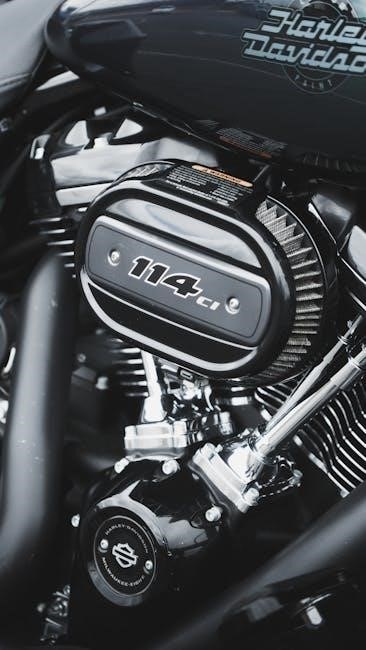
Fuel System Problems & Solutions
Harley-Davidson service manuals dedicate significant sections to fuel system diagnostics, recognizing its critical role in engine performance. Common issues addressed include carburetor malfunctions – detailing cleaning, rebuilding, and jetting procedures for older models. For fuel-injected bikes, manuals provide pinpoint tests for fuel pumps, injectors, and the fuel pressure regulator.
Troubleshooting guides cover lean or rich running conditions, explaining how to identify and correct them through adjustments or component replacement. Detailed wiring diagrams assist in diagnosing fuel pump relay or sensor failures. The manuals emphasize the importance of clean fuel filters and lines, offering specific instructions for inspection and replacement.
Furthermore, they outline procedures for diagnosing vapor lock, a common issue in warmer climates, and provide guidance on ethanol-related fuel system concerns. Step-by-step instructions, accompanied by clear illustrations, empower both novice and experienced mechanics to effectively resolve fuel system problems.
Electrical Faults & Repair
Harley-Davidson service manuals provide extensive coverage of electrical system diagnostics and repair, crucial for resolving complex issues. They include detailed wiring diagrams, component location charts, and testing procedures for all electrical circuits. Common faults addressed encompass faulty starters, alternators, voltage regulators, and lighting systems.
Manuals guide users through pinpoint testing, utilizing multimeters and test lights to isolate short circuits, open circuits, and ground faults. Specific instructions are provided for checking battery condition, fuse integrity, and relay operation. Troubleshooting guides cover issues like intermittent electrical problems and charging system failures.
Furthermore, they detail procedures for repairing or replacing wiring harnesses, connectors, and sensors. Emphasis is placed on proper grounding techniques and the use of dielectric grease to prevent corrosion. Clear illustrations and step-by-step instructions empower mechanics to confidently diagnose and repair electrical faults.
Engine Performance Issues & Diagnosis
Harley-Davidson service manuals dedicate significant sections to diagnosing and resolving engine performance problems. These manuals offer systematic approaches to identify issues like poor fuel economy, reduced power, rough idling, and excessive smoke. Detailed specifications for compression, leak-down, and ignition timing are provided as benchmarks for evaluation.
Troubleshooting charts guide technicians through a logical process of elimination, checking components like carburetors, fuel injectors, ignition modules, and sensors. Procedures for testing and adjusting these systems are clearly outlined. Manuals also cover diagnostic techniques using specialized tools, such as fuel pressure gauges and scan tools.
Furthermore, they detail how to interpret diagnostic trouble codes (DTCs) and pinpoint the root cause of engine malfunctions. Instructions are included for performing engine inspections, identifying worn components, and implementing necessary repairs or replacements to restore optimal performance.